YatriKart’s transit-retail journey takes a larger turn with MMG store pact
YatriKart’s reported Rs 120 crore store partnership puts operating execution and supplier economics in focus for small businesses.
In 30 seconds
- YatriKart has built its model around shoppers at transit points and other high-footfall locations.
- A reported five-year MMG partnership would support 1,000 stores, with investment and operations handled separately.
- For small suppliers, actual purchase orders and payment terms matter more than expansion targets.
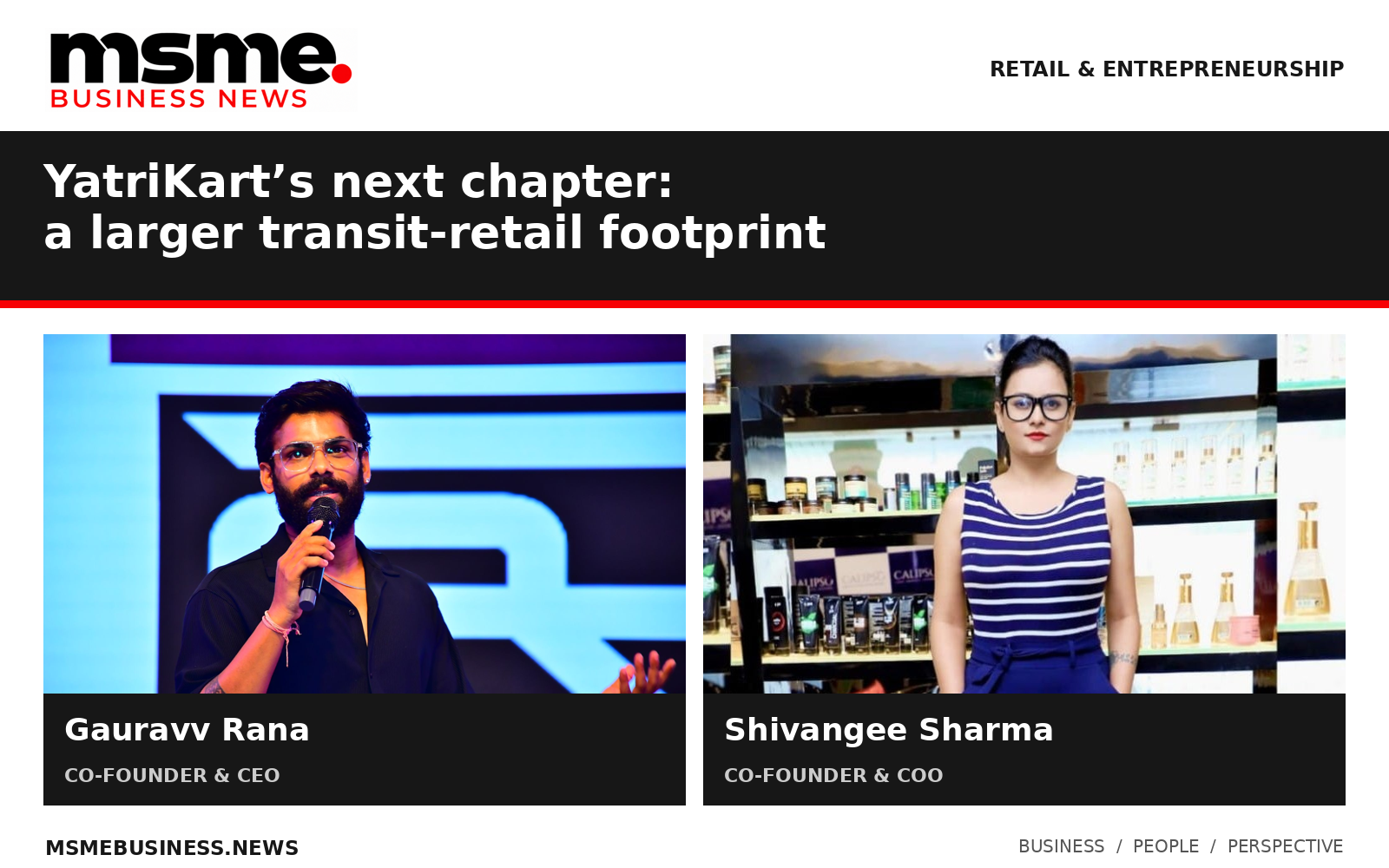
YatriKart has developed its convenience-retail business around places where customers are already travelling, waiting or working. The company identifies Gauravv Rana as co-founder and chief executive and Shivangee Sharma as co-founder and chief operating officer. Its proposition is a compact shop carrying everyday products rather than a delivery service built around a home address.
Its own account of the business traces a progression from railway carts in 2021 to Delhi Metro platforms and hotel outlets in 2022, followed by partnerships with retailers and fuel-station networks. These are company-reported milestones. They describe how the format evolved, but references to locations, partner opportunities and operating stores should not be treated as interchangeable measures of scale.
Today, YatriKart lists transit hubs, petrol pumps, hospitals and colleges among its target settings. Its product range includes snacks, stationery, mobile accessories and other essentials. That combination makes the business relevant to smaller consumer brands looking beyond supermarkets and online marketplaces. A compact outlet can offer another route to the customer, although shelf access and repeat orders still depend on product demand and commercial terms.
For an MSME supplier, a growing network is an opportunity to investigate, not a confirmed sales pipeline. Questions worth settling include which entity places orders, how stock is replenished, who carries unsold inventory, and when invoices become payable. A large number of proposed stores says little by itself about the working capital a supplier may need.
Business Standard reported on 20 October that YatriKart and MMG Group had agreed a five-year, Rs 120 crore arrangement covering 1,000 outlets. Under the reported franchise-invested, company-operated model, MMG would finance infrastructure and capital expenditure, while YatriKart would handle operations, staffing, technology and supply chain. The figure describes the reported rollout commitment, not a verified Rs 120 crore equity funding round or money already deployed.
The report puts the initial focus on 100 stores in Delhi NCR and says the relationship follows an earlier MMG equity investment. The practical test will be completed openings, repeat customer demand and sustainable store economics, rather than the headline size of the proposed network.
Sources & further reading
- YatriKart: Our Story (company account)
- YatriKart: locations and products
- Business Standard, 20 October 2026: MMG partnership report
Disclosure & image credits
Sources: YatriKart’s company website and Business Standard’s 20 October report. Partnership terms are attributed to that report; the agreement itself was not available for inspection. Checked 21 October 2026. MSME implications are editorial analysis.
Image credit: Photos: YatriKart official founder page. Editorial layout: MSME Business News. · Photo source